Finding Support During Demanding Times
A Gentle, Grounded Guide
When Life Feels Purposeful and Emotionally Heavy
Some seasons of life are full of meaning, opportunity, growth, and connection. At the same time, these periods can feel emotionally overwhelming. Even when something feels purposeful, the emotional weight of responsibility, high expectations, and ongoing change can be exhausting.
Recent global research shows that emotional stress is not limited to brief periods of difficulty, but represents a sustained and growing pattern across populations worldwide. Studies examining large populations over time found that psychological stress increased in more than 85% of countries between 2008 and 2021, with adolescents and young adults experiencing the sharpest declines in emotional well-being (Piao et al., 2024). These patterns reflect how increasing demands on time and energy may be impacting people’s ability to manage stress and maintain mental well-being.
A full or meaningful life does not eliminate mental health challenges. Emotional struggles can exist alongside purpose and success, and they deserve care and understanding.
Why High-Demand Periods Can Feel So Overwhelming
When routines change and responsibilities grow, emotional balance becomes harder to maintain. Stress accumulates quietly when sleep becomes interrupted, time for rest disappears, and demands crowd the few moments available for recovery.
Sleep is particularly powerful in shaping emotional stability. Research shows that inconsistent and insufficient sleep increases emotional reactivity and makes stress harder to manage, especially during prolonged periods of pressure (Zhang et al., 2026). When stress accumulates without adequate recovery, it becomes harder to regulate mood, make decisions, and maintain perspective.
This emotional burden is not limited to a small group of individuals. Large meta-analyses indicate that during periods of widespread uncertainty, such as the COVID-19 pandemic, more than one in four people experienced clinically significant levels of depression or anxiety (scores on validated scales indicating symptoms likely to interfere with daily life), and over one in three experienced stress severe enough to disrupt normal functioning (Nochaiwong et al., 2021).
These data reflect real patterns in lived experience. The emotional strain of managing multiple pressures at once cannot be dismissed as normal busyness. It affects your overall quality of life, including sleep, relationships, work performance, and physical well-being (World Health Organization, 2025).
Recognizing When Additional Support May Be Helpful
Emotional strain can grow gradually until it begins to interfere with everyday life. You might notice changes in sleep quality, a sense of detachment from loved ones, difficulty concentrating, or a heaviness that makes even small decisions feel harder than they used to.
Seeking support is a strength-based and strategic choice, not a last resort. Research shows that early mental health care can reduce symptom severity, strengthen coping capacity, and protect against more serious outcomes such as prolonged burnout, emotional crises, or withdrawal from meaningful activities (World Health Organization, 2025).
Mental health support is not one-size-fits-all. It can include therapy, psychiatric care, structured coaching, peer support, or practices focused on consistent emotional awareness and regulation. What unites effective care is responsiveness to change and continuity over time.
Staying Connected to Care When Life Is Busy
When life feels demanding, it is easy to assume help is out of reach. Schedules fill quickly, priorities shift, and emotional needs are often postponed. Yet research and clinical experience consistently show that mental health support is most effective when it remains steady, even during busy periods.
Digital mental health tools are now part of a modern care ecosystem that helps bridge gaps between clinical appointments and real-world emotional shifts (World Health Organization, 2025). That is why we created Precise Digital, apps built with people in mind. Designed for both youth and adults, our apps provide support during difficult moments through daily engagement, early detection of emotional changes, and clinician-guided support.
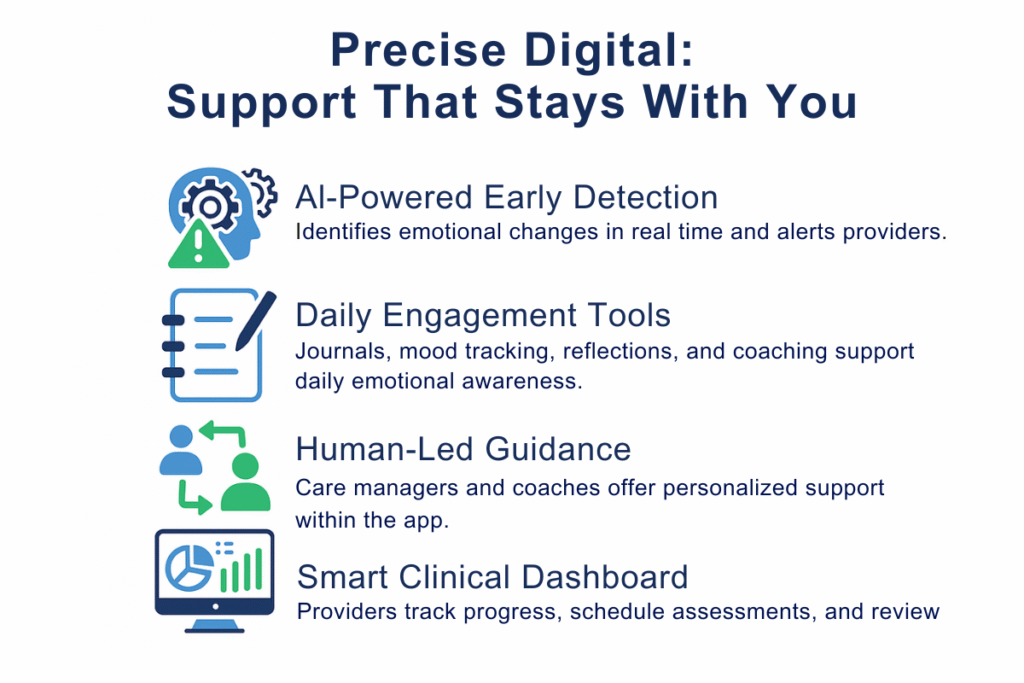
Through daily journaling, mood tracking, reflections, and structured assessments, individuals stay connected to their care. Artificial intelligence identifies patterns of emotional change early, helping clinicians intervene before distress escalates to a crisis.
Continuity is especially important when routines are disrupted and emotional signals are harder to notice. Digital engagement provides a steady presence between appointments, ensuring individuals aren’t left waiting until distress becomes overwhelming before support arrives.
Small Practices That Protect Your Emotional Energy
Simple, consistent practices can help support emotional balance during stressful times. These are small steps you can begin practicing today to gently support your mental health. They are not meant to solve everything, but to offer moments of grounding and care when life feels heavy.
- Create moments of pause
Brief pauses throughout the day give your mind and body space to reset. A minute of slow breathing, quiet reflection, or a short walk can help reduce stress and soften emotional intensity. - Honor your limits
Awareness of your emotional and physical capacity protects well-being. Adjusting plans, choosing rest, or setting boundaries is a form of self-care, not avoidance. Respecting limits helps prevent burnout before it builds. - Keep one calming routine steady
Maintaining at least one consistent routine can create a sense of stability. A regular sleep schedule, gentle movement, journaling, or a calming morning or evening ritual can help anchor your day. - Build safe and supportive connections
Not all social interaction feels restorative. Time spent with people who help you feel calm, heard, and understood strengthens emotional safety and reduces isolation. - Check in with yourself daily
A brief emotional check-in helps you notice shifts in mood, stress, or energy. Responding early supports emotional regulation, clarity, and self-trust.
Making Space for Care in Every Season
You do not have to be consistently productive, positive, or emotionally steady. Human life is complex, and demanding periods call for support rather than self-judgment.
Care can come from many sources, including clinicians, trusted relationships, daily practices, and tools that help track emotional changes over time. Platforms like Precise Digital combine technology with human care to help individuals feel seen, supported, and guided every day.
Protecting emotional well-being today helps preserve capacity for tomorrow. You deserve support that moves with your life, not separate from it. When mental health care is responsive and continuous, it supports not just individuals, but the systems and communities that depend on their well-being.
Sources:
- Piao, X., Xie, J., & Managi, S. (2024, December 23). Continuous worsening of population emotional stress globally: Universality and variations – BMC public health. SpringerLink. https://link.springer.com/article/10.1186/s12889-024-20961-4?utm.com
- Zhang, J., Xiang, S., Li, X., Tang, Y., & Hu, Q. (2026, January 28). The impact of stress on sleep quality: A mediation analysis based on Longitudinal Data. Frontiers. https://www.frontiersin.org/journals/psychology/articles/10.3389/fpsyg.2024.1431234/full.
- Nochaiwong, S., Ruengorn, C., Thavorn, K., Hutton, B., Awiphan, R., Phosuya, C., Ruanta, Y., Wongpakaran, N., & Wongpakaran, T. (2021, May 13). Global prevalence of mental health issues among the general population during the coronavirus disease-2019 pandemic: A systematic review and meta-analysis. Nature News. https://www.nature.com/articles/s41598-021-89700-8?utm.com
- World Health Organization. (2025). World health statistics 2025: monitoring health for the SDGs, sustainable development goals. https://iris.who.int/server/api/core/bitstreams/9a7862cb-3749-4dc3-af6c-402fa91c8559/content
Written by Gabriella Aaron
About the Authors
Gabriella Aaron is a Clinical Research and Content Development Specialist at Precise Behavioral, Inc., with a background in Medical Microbiology and a passion for digital mental health solutions.
Editorial Contributors
This piece was edited by Greta Baker and Kirsten Guiliano.