
A therapy session provides dedicated time to pause, reflect, and talk openly about your thoughts, emotions, challenges, and experiences. It can also offer an opportunity to develop practical coping strategies, explore patterns and behaviors, and work toward meaningful personal goals with the support of a behavioral health professional.
Mental health is part of everyday life, influencing how we feel, think, and respond to what happens around us. A stressful workday can leave you feeling overwhelmed, while a difficult conversation may stay on your mind for hours. Even something as simple as a restless night can affect your mood and energy the next morning.
Positive moments matter, too. Spending time with someone you care about, moving your body, getting enough rest, enjoying a favorite activity, or taking a few quiet minutes for yourself can make a difference in how you feel. These everyday experiences can shape your emotional well-being and influence how you move through the rest of your day.
Mental health extends beyond the time spent in therapy. What happens between appointments can be just as meaningful as what happens during them.
Paying attention to your experiences throughout the day can help you recognize patterns, notice changes in how you’re feeling, and practice the skills you’re developing in therapy. These observations can also give you valuable insights to bring back to your care team, helping make conversations more focused and connected to what you’re experiencing in everyday life.
Noticing What Happens Between Sessions
What happens between therapy sessions can offer useful insight into your mental and emotional well-being. You may notice changes in your mood, reactions, energy, sleep, relationships, or ability to manage everyday demands.
Taking a moment to notice these experiences can help you recognize patterns and identify what may be helping or making things more difficult. Over time, these observations can become useful information to bring into therapy, helping you and your care team better understand what you are experiencing and what support may be most helpful.
Some moments may have an obvious emotional impact, while others may seem insignificant at first. Over time, however, everyday experiences can provide valuable context for changes in mood, stress, energy, behaviors, and routines.
Mental health care does not have to begin and end with what is discussed during an appointment. What happens before, after, and between sessions can offer additional insight into how someone is doing and how they are responding to the strategies they are learning.
Research supports the potential value of between-session activities. A 2023 systematic review found positive effects on intermediate outcomes, particularly when activities were connected to treatment goals and collaboratively integrated into therapy (Ryum et al., 2023).
The goal is not to turn every part of the day into a therapeutic exercise. Rather, everyday life can provide opportunities to apply what is discussed in therapy, notice what works, and identify experiences that may be helpful to explore in a future session.
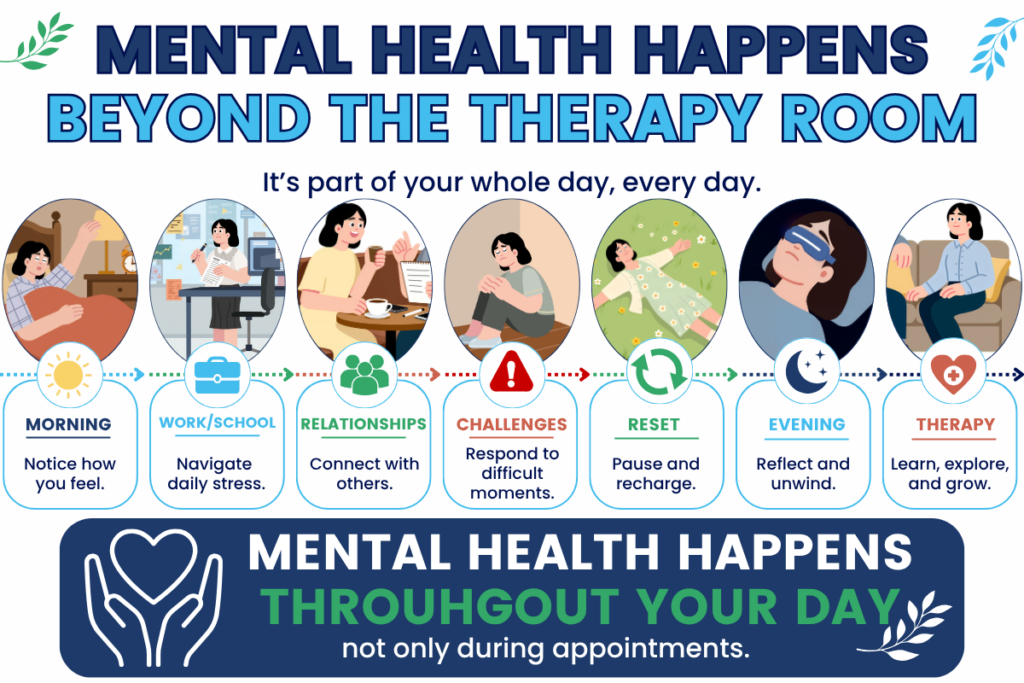
The Moments Between Appointments Matter
A great deal can happen between one appointment and the next. Someone may learn a breathing technique during therapy and find themselves using it several days later before a stressful conversation. Another person may discuss sleep with their therapist and begin noticing that their energy or mood changes after nights when they do not sleep well.
These experiences can provide information that is difficult to capture during an appointment alone. A strategy that feels manageable in a calm therapy room may feel different when used in the middle of a stressful situation. Noticing that difference can help clarify what feels helpful, what remains challenging, and what may be worth exploring further with a care team.
Research on between-session activities suggests that therapeutic work outside of sessions may help translate what is learned in therapy into changes in everyday life (Ryum et al., 2024).
Noticing How You Feel Can Be a Starting Point
Staying engaged with your mental health does not always require doing something significant. Sometimes it begins by taking a moment to ask, “How am I feeling today?”
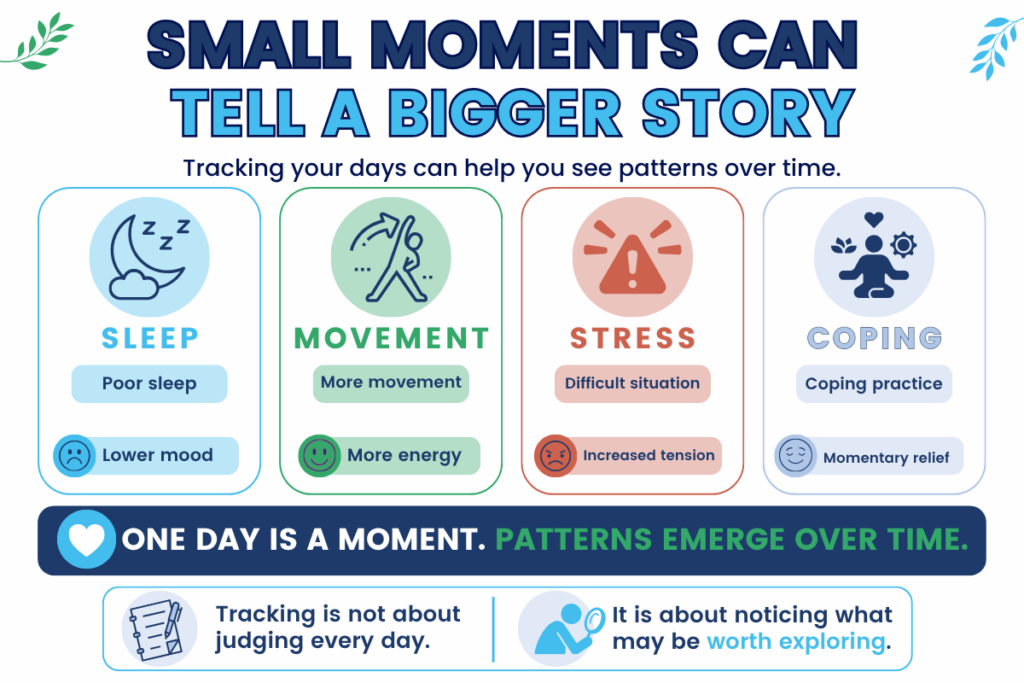
A brief check-in can create space to notice mood, thoughts, energy, or stress without immediately trying to change what you are experiencing. Over time, these observations may also make certain changes easier to recognize. You may notice that stressful workdays affect your mood, that movement tends to leave you feeling more energized, or that certain situations consistently make it harder to unwind.
Research using ecological momentary assessment has explored how mood and anxiety symptoms can be examined within everyday life through repeated, in-the-moment observations. This approach can provide a more detailed picture of how psychological experiences fluctuate across different situations and points in time (Hall et al., 2021).
A single check-in is not intended to explain why someone feels a certain way. Its value comes from creating a moment of awareness that can contribute to a broader understanding over time.
Reflection Can Add Context
Noticing an experience is one step. Taking time to reflect on it can help provide additional context.
Journaling is one way to do this. Writing about a difficult situation may help someone organize their thoughts, while recording a positive experience can make moments of progress easier to recognize. Reflection can also happen without writing. A quiet walk, mindfulness practice, conversation with someone you trust, or simply a few uninterrupted minutes to think can provide opportunities to process what happened and how you responded.
Questions such as “What happened?” “How did I respond?” “What helped?” or “Is there anything I want to remember?” can turn an everyday experience into something worth exploring further.
The goal is not to analyze every thought or emotion, but to create space to better understand experiences that might otherwise pass unnoticed.
Digital tools can also make it easier to capture these reflections when they happen, helping people keep track of thoughts, emotions, and experiences between appointments.
Research suggests that engagement with digital mental health tools is strongest when technology supports, rather than replaces, the therapeutic relationship. Features that encourage reflection, goal tracking, communication, and guided coping can complement therapy while keeping people connected to their care journey (Zainal et al., 2025; Malouin-Lachance et al., 2025).
Coping Happens in Real Time
Therapy can provide a supportive environment for learning and discussing coping strategies, but everyday life is often where those strategies are put into practice.
A breathing exercise may help someone slow down before an important conversation. Grounding techniques may provide support during an overwhelming moment, while mindfulness can create a brief pause during a stressful afternoon. Practicing these skills in real situations can help people discover which strategies feel useful, when they are most helpful, and what they may want to continue exploring in therapy.
Between-session practice can help connect therapeutic learning with everyday experiences. Research has examined these activities as one potential pathway through which skills and strategies introduced in therapy may be carried into daily life and contribute to change outside the therapy setting (Ryum et al., 2024).

Small Moments Can Reveal Bigger Patterns
Looking at experiences over time can sometimes reveal patterns that are easy to miss in the moment. Rather than focusing on whether a single day was “good” or “bad,” paying attention to recurring experiences can provide helpful context about mood, stress, energy, sleep, and coping.
For example, you may notice feeling more overwhelmed during particularly busy parts of the week, having difficulty concentrating when stress builds, or feeling calmer after practicing a coping strategy. These observations do not explain why something is happening, but they can help identify patterns and experiences that may be worth exploring during therapy or with your care team.
Bring What You Notice Back Into Care
The value of noticing patterns is not simply becoming more aware of your experiences. It is also having meaningful observations to bring into conversations with your behavioral health professional.
It can be difficult to remember several weeks of experiences when someone asks, “How have you been?” Brief notes about changes in mood, stressful situations, coping strategies that felt helpful, or questions that came up between appointments can make those conversations more specific and productive. These everyday observations help connect life outside the therapy room with the work happening during care.
Staying Connected Beyond Scheduled Appointments
At Precise Behavioral, we recognize that behavioral health is shaped by experiences that occur both during and between scheduled appointments. Supporting the broader care journey means considering how people can remain engaged with their mental health as they move through everyday life.
Precise Digital was designed to help extend that support by bringing mental health and wellness resources into one accessible space. Features such as mood check-ins, journaling, guided meditations, breathing exercises, educational articles and videos, wellness coaching, daily tips, and communication with the care team can provide opportunities to reflect, learn, and practice coping strategies, while staying connected outside scheduled visits.
The purpose of these tools is not to recreate therapy on a phone or replace professional behavioral health care. Instead, they can help make supportive resources more accessible during the moments when people need help and do not have access to traditional or in-person care right at that moment.
Mental Health Happens Everywhere
Mental health is woven into experiences that may not look like mental health care at all. It can be reflected in how someone handles a demanding morning, responds to a stressful conversation, recognizes the need for rest, spends time with people they care about, or uses a coping strategy when emotions become difficult to manage. It can also appear in quieter forms of progress, such as noticing a familiar challenge and realizing that it feels a little easier to navigate than it once did.
These moments may seem small individually, but together they can provide valuable context about how someone is feeling, what may be influencing their well-being, and where additional support could be helpful. Therapy can provide a dedicated space to understand these experiences, while reflection, coping, self-monitoring, education, and connection can help people remain engaged with their mental health beyond the therapy room.
At Precise Behavioral, this broader view of behavioral health is central to how we think about support. Through Precise Digital, individuals can access tools designed to complement care and help them stay connected to their mental health throughout daily life.
The goal is not to make every moment about mental health. It is to make meaningful support more accessible within the moments that make up real life.
Ways to Stay Connected With Your Mental Health
- Check in with yourself: Take a moment to notice how you are feeling without judging the answer.
- Write it down: Record thoughts, emotions, experiences, or observations you may want to revisit.
- Practice a coping skill: Use breathing, grounding, mindfulness, or another strategy when it feels helpful.
- Notice patterns: Pay attention to how mood, sleep, activity, stress, and routines may relate over time.
- Keep learning: Use trusted behavioral health resources to better understand mental health and wellness.
- Stay connected: Bring meaningful questions, observations, or concerns into conversations with your care team.
- Make space for wellness: Allow room for rest, movement, connection, and reflection within your routine.
Mental health is not confined to one room or one hour of the week. It develops within the relationships, responsibilities, challenges, routines, and experiences that shape our lives.
The therapy room matters. So does everything that happens beyond it.
Sources:
- Hall, M., Scherner, P. V., Kreidel, Y., & Rubel, J. A. (2021). A systematic review of momentary assessment designs for mood and anxiety symptoms. Frontiers in Psychology, 12, 642044. https://doi.org/10.3389/fpsyg.2021.642044
- Malouin-Lachance, A., Capolupo, J., Laplante, C., & Hudon, A. (2025). Does the digital therapeutic alliance exist? Integrative review. JMIR Mental Health, 12, e69294. https://doi.org/10.2196/69294
- Ryum, T., Bennion, M., & Kazantzis, N. (2023). Integrating between-session homework in psychotherapy: A systematic review of immediate in-session and intermediate outcomes. Psychotherapy, 60(3), 306–319. https://doi.org/10.1037/pst0000488
- Ryum, T., Bennion, M., & Kazantzis, N. (2024). Between-session homework and processes of change. Journal of Clinical Psychology, 80(4), 928–937. https://doi.org/10.1002/jclp.23637
- Zainal, N. H., Wang, V., Garthwaite, B., & Curtiss, J. E. (2025). What factors are related to engagement with digital mental health interventions (DMHIs)? A meta-analysis of 117 trials. Health Psychology Review, 20(1), 151–171. https://doi.org/10.1080/17437199.2025.2547610
Written by Gabriella Aaron
About the Authors
Gabriella Aaron is a Clinical Research and Content Development Specialist at Precise Behavioral, Inc., with a background in Medical Microbiology and a passion for digital mental health solutions.
Editorial Contributors
This piece was edited by Greta Baker and Kirsten Guiliano.