Published on:

CEOCFO: Dr. Nanda, would you give us a glimpse into why you founded this company?
Dr. Nanda: I am a trained clinician – a geriatric psychiatrist. I am currently a member of the clinical faculty in the Geriatric Psychiatry Division of the UCLA David Geffen School of Medicine and continue to enjoy the teaching aspect of my clinical journey. My entire career has been all about building companies in behavioral health to improve access, and I have also taken an entrepreneurial journey. Precise Behavioral is now my third company. Previously, I started and sold two other companies. The first one was a brick-and-mortar hospital-list business, Psychiatric Hospitalist that delivered geriatric psychiatry to nursing homes for seniors. I sold that business to Inpatient Consultants, which was later acquired by Team Health.
I formed my second company, Aligned Telehealth which was focused on on-demand tele-psychiatry services and telemedicine. Aligned significantly improved rural healthcare delivery by extending care into remote locations. This work led to the company’s acquisition by American Well (Amwell), which is now public.
I then took some time off and realized there was still a lot more to do in behavioral health as an industry. I advanced telehealth for psychiatry at Aligned, and that did a lot to improve access. But that alone was not enough. I came back into the market for a third time to build something much bigger and more impactful: a truly connected system that brings technology, clinicians and operations together across every care setting. This is what my current company, Precise Behavioral, is all about. I was fortunate to have a lot of my former team and colleagues come back to work for me. We picked up where we left off.
CEOCFO: Would you tell us about Precise Behavioral?
Dr. Nanda: Precise Behavioral provides end-to-end behavioral health solutions to hospital systems, nursing homes, residential care, out-patient services, and correctional facilities (prisons and jails). As a company, we have over 100 years of deep behavioral health experience across our leadership team. Clinician led and founded; we are clinicians and operators who have actually done the work. Our customers trust us because we speak their language and keep our promises. Our operations team knows how to execute. We have collectively been servicing the health system and Skilled Nursing Facility (SNF) segment for over 20+ years.
This third time around, I realized that many hospitals were being forced to work with several different vendors in behavioral health. They were using a single point solution for each care setting across their hospitals. There was still a big lack of infrastructure in terms of technology combined with clinical services for behavioral health. Precise set out to tackle this problem.
CEOCFO: Are you the first to try something like this?
Dr. Nanda: I think people have tried to offer a unified operating system in different vertical industries, but healthcare is still trying to simplify workflows. Today, behavioral health service line owners inside of hospitals have one solution for inpatient, another for emergency rooms, and still another for outpatient. But none of these individual solutions have connectivity with each other, which causes fragmentation of data and loss of coordinated care. What makes us different is that we work across the entire care continuum. A lot of hospital and health systems are looking for this type of continuity.
The other thing that we do differently is provide both in-person and virtual care. When COVID hit, we had a robust platform that was able to offer virtual psychiatry and therapy to hundreds of thousands of patients. Coming out of COVID, many patients wanted to go back to seeing their doctor or therapist in person, so we offered a hybrid model. We also have digital apps that send out patient assessments and surveys to help with risk-profiling, and we monitor patients’ in-between visits.
CEOCFO: How do you differ from the traditional point solution telepsychiatry?
Dr. Nanda: Telepsychiatry is just one offering on our platform; we provide in-person visits as well. But more than just virtual clinical services, we offer an entire Behavioral Health Operating System (BOS) that allows us to follow a patient throughout their entire care journey. Part of our platform also addresses a hospital’s financial needs, as most health systems don’t specialize in behavioral health codes and routinely leave insurance reimbursement on the table. So, we built a specialized billing system in-house. We also do all of our own provider recruitment and credentialing in-house as well.
CEOCFO: Is your system easy to implement?
Dr. Nanda: Yes, we work in a modular format, so we allow our customers to pick and choose what they need from our entire solution set. This could be on-demand doctors and care managers that see patients inside the hospital or after discharge with one of our digital applications, or even our virtual clinic in outpatient settings. Remember, we service different organizations like hospitals, primary care offices, nursing homes, and residential care. We can provide an entire end-to-end platform or customers can just use one or two of our applications to get started. We also have the ability to integrate into our customer’s existing Electronic Health Record (EHR) systems, as well as their queue management, referral workflows and care navigation. We can do screening and assessment, deliver care and track patients in-between visits. Our digital apps, our like “eye in the sky” in that we can monitor and track patients across their entire care journey – from an emergency room visit, to being discharged and 1-2 visits after that, all the way into ongoing therapy. We make it all very seamless.
CEOCFO: Do you send someone to the hospital or facility to set up the system, or is this something you can send to them?
Dr. Nanda: It depends on the type of customer we are servicing, whether they are a hospital or an outpatient clinic, or a nursing home. We often do a lot of the implementation and set up virtually. It can be done expeditiously, or we can do it
in person if it requires more integration into a hospital’s inpatient workflows and data systems. Once we sign up our customer and start onboarding them, we immediately assign a team of doctors, therapists, or social workers to their account or recruit specific clinicians and get them credentialed. We then get them trained on the client’s EHR, and work on a referral capture process to start seeing patients. The workflows for consult requests and referrals are embedded into our platform. We also have SLAs with our clients that specify our commitment to “time to treat” patients – either 60 minutes in the emergency room or within 24 hours across the hospital.
We have had several instances where a new hospital prospect will call us with a fire drill. They are backed up in their emergency rooms with psychiatric consults. They come to us to ask for immediate help to decompress their emergency rooms, and we say, “of course we can help you”. We bring in our clinicians and get them credentialed right away using our in-house credentialing tooling. We also swiftly integrate into their hospital workflows and EHRs and provide necessary care immediately to patients in need.
CEOCFO: Do you incorporate AI?
Dr. Nanda: Yes, we do leverage AI but we made a philosophical decision early on. We will never use AI to replace a psychiatrist, therapist, or social worker. We will use it only to make our clinicians more efficient by improving patient documentation, risk scoring, triage, and patient engagement. For that reason, mainly, we are investing in layering AI across our entire tech stack.
On our product road map, we are also planning to use AI to ingest more data points. AI will help us integrate more data from a patient’s history, medications, utilization patterns, and wearables. Ultimately, this will help us better see where patients are on the risk-continuum.
CEOCFO: Would you describe yourself as an all-in-one type platform to even improve their financial situation, make money?
Dr. Nanda: Yes, we do help our customers with their financial bottom line. Recruiting psychiatrists to hospitals is widely considered one of the most difficult and time-intensive hiring challenges in healthcare. Most health systems have significant behavioral health labor shortages and struggle with recruiting clinicians. The lack of local clinical talent has a significant downstream effect on the health system’s bottom line with regard to length of stay, unstaffed consult requests, longer inpatient stays, and behavioral health service lines that run at a loss. We help address all of these financial issues.
But at its core, this all starts with access to care. Today, there is a huge need for therapists and psychiatrists across the country. Roughly 60% of the practicing psychiatrists are over the age of 50 and will be retiring soon. There are 22 million Americans who are in designated mental health professional shortage areas. In fact, we will need another 50 thousand psychiatrists by 2026 to provide care to patients in need.
Many hospitals are having to incur the financial burden of treating the mentally ill across emergency rooms, clinics and hospitals. Hospitals are absorbing the cost but at a loss, and we help fix this situation.
CEOCFO: How long have you been in the market and what would you say is your capture of the market share; are you strictly U.S.? Are you looking to go global?
Dr. Nanda: We are currently in the U.S. only right now and our goal is to continue to expand domestically. Our therapists and psychiatrists are licensed in 44 states, and we actively operate deeply in 11 states. We could deploy our Behavioral Operating System (BOS) and digital applications outside of the U.S. right now if an opportunity arose. But there is still a huge need domestically to expand, so we are focusing there first.
CEOCFO: Do you run into any resistance from clinicians and hospitals?
Dr. Nanda: I think it’s a sigh of relief when we come in and tell a customer we can help them immediately augment their clinical services. Health systems choose us because they have access to care issues. They simply do not have enough
clinicians to service patient demand. They want to work with us as their partners for behavioral health. That is their number one priority – get patients the care they need and fast.
Earlier in my career, in my previous company, Aligned Telehealth, we had some customers who were resistant to bringing telehealth into their health systems but then COVID hit and everyone wanted a telemedicine solution. We had thousands of patients and providers sign up. The early naysayers rushed to us and said they needed an immediate solution to provide care to patients and to sustain themselves financially during the pandemic.
“What people like about Precise Behavioral, my current company, is that we are combining on-demand clinical services with a full digital technology solution. Our customers also like that we provide care across different care settings–inpatient, the emergency room and outpatient – all on one singular and unified platform.”
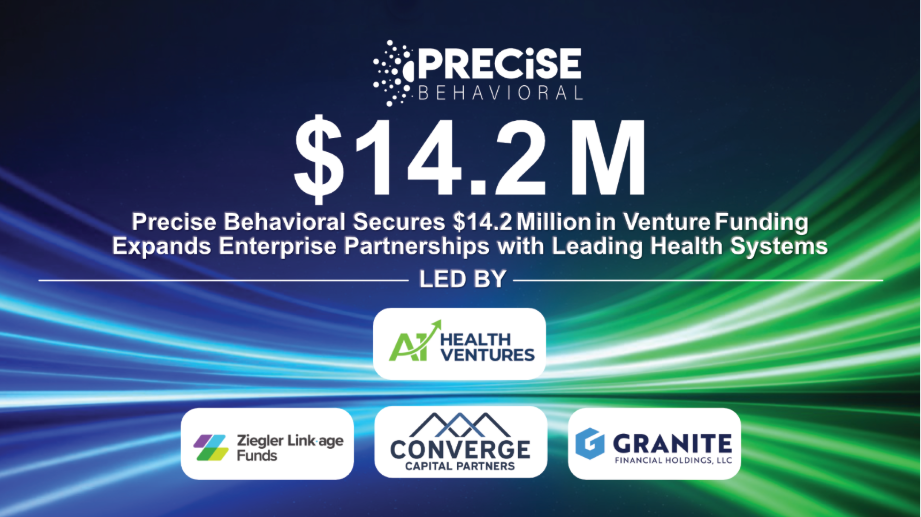
Also, if you look at our investors in our recently announced $14.2M venture round, they signal both market demand and alignment, as many of them are strategically representing our buyers. A1 Health is made up of some of the largest health systems across the country as their LPs. Ziegler Link•age Fund invests in post-acute and aging markets and Converge Capital Partners works with the largest hospital associations across the country. Lastly, Granite Financial Holdings, an affiliate of Blue Cross of Idaho is helping us think about how to work strategically with the health insurance plans.
CEOCFO: Are you interested in investors, or are you looking to raise capital, or are you looking at partnerships?
Dr. Nanda: The company was profitable in under three years, and we just completed our first institutional financing. Our solution has been very well accepted by the market. That’s because we were able to demonstrate ROI and clinical outcomes and that led us to traction in the market. I also believe that it’s because my team and I are very well known and trusted in the market from our previous exits in behavioral health.
I think our goal right now is to continue to expand and grow. Our hope is that we won’t need to raise additional capital. We are taking our new funds and expanding our leadership team, adding bench strength to our national clinical network, and investing in our AI across our technology platform.
CEOCFO: This is a solution that seems to help clinicians and organizations to function better and also help them with their financial bottom line. What about the patient side? What does this mean for a patient who is struggling with mental health issues?
Dr. Nanda: If you look at the various care settings we work across –inpatient care, the emergency department, and hospital owned primary care offices — behavioral health still has an overwhelming unmatched need against patient demand. There are patients who are waiting to see a psychiatrist for 12, 14, or even 24 hours. We see them within an hour and get them an immediate disposition, which means a decision for what the next level of care is – like an admission, a discharge, or a further examination. Patients really appreciate the speed to treat and level of care.
A lot of older patients also need behavioral health. This is the kind of specialty I focus on as I am a trained geriatric psychiatrist. There are seniors with cognitive impairment who generally wait for months to see a psychiatrist. There are also thousands and thousands of patients with eating disorders and depression in line to be seen. We are bringing both care and technology solutions to these patients and immediately increasing their access to care, ongoing monitoring and care coordination. All of this makes patients feel seen and heard and gets them the care they need.
Read the Full Interview
Explore the full conversation with CEOCFO Magazine to learn more about Precise Behavioral, its approach to behavioral healthcare, and the company’s vision for the future.
Read the Full Interview at CEOCFO Magazine → https://www.ceocfointerviews.com/precisebehavioral0826.html
Featured interview published by CEOCFO Magazine, September 2,2026.