
Exploring the psychology of holiday expectations, hidden emotional strain, and the importance of understanding how we truly feel.
The invitations are arriving, holiday music is playing, and conversations are shifting toward celebrations, family gatherings, and plans for the new year. For some, these moments bring excitement and comfort. For others, they stir emotions that are more difficult to explain. A familiar holiday tradition may no longer bring the same joy, an upcoming gathering might evoke anxiety rather than excitement, or memories of previous celebrations could stir unexpected feelings of sadness.
The holiday season often carries an unspoken expectation that people should feel happy, grateful, and connected. Yet personal circumstances do not always align with these expectations. Financial difficulties, complicated relationships, changing family dynamics, and the absence of loved ones can make celebrations emotionally demanding. Even positive experiences may be accompanied by exhaustion, disappointment, or grief for the people, relationships, and stages of life that have changed.
In a 2025 Healthy Minds Poll, the American Psychiatric Association reported that 41% of U.S. adults anticipated greater holiday-related stress than the previous year, compared with 28% in 2024. Nearly half expressed concern about missing someone or experiencing grief, while 46% worried about affording or finding holiday gifts (American Psychiatric Association, 2025).
These findings challenge the assumption that the holidays are universally joyful. They also highlight an important psychological experience: the discomfort that can arise when our emotions do not match what we believe we should be feeling.
Understanding this disconnect can help us recognize the pressures, memories, and emotional needs that influence our experiences during the holidays while creating space for a more realistic and compassionate approach to mental well-being.
The Happiness Paradox: When Celebration Becomes Pressure
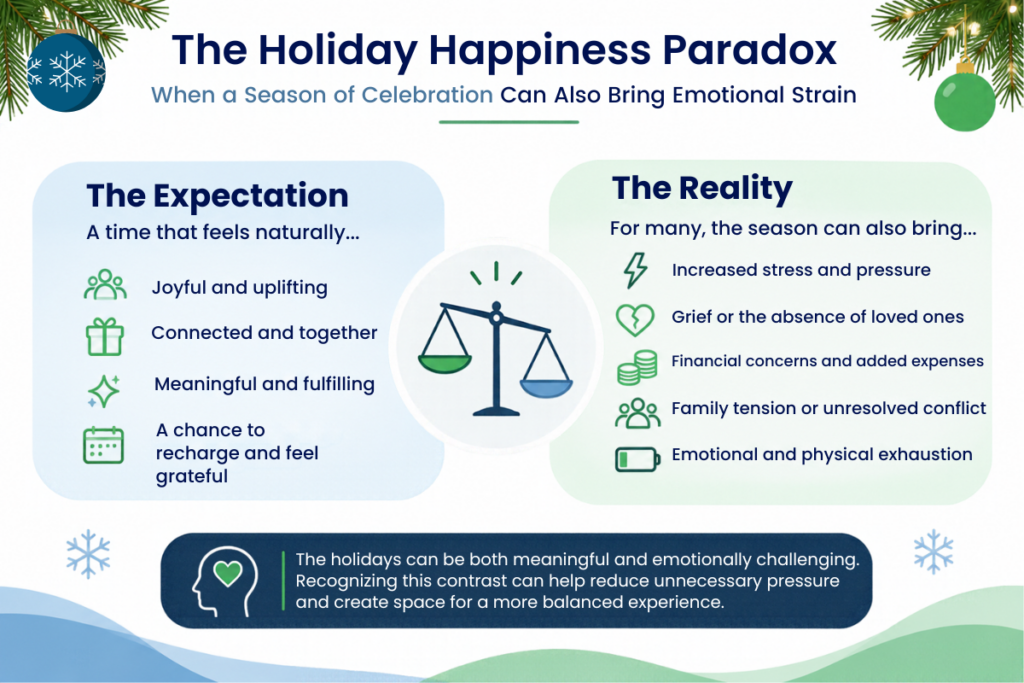
Holiday celebrations are often associated with happiness, gratitude, generosity, and togetherness. Advertisements showcase picture-perfect gatherings, holiday films portray heartwarming reunions, and familiar traditions encourage people to embrace the excitement of the season. These experiences can be meaningful, but they can also establish unrealistic expectations about how the holidays should look and feel.
Someone navigating a difficult relationship may feel uncomfortable attending a family gathering where unresolved tensions are likely to surface. A parent experiencing financial uncertainty may feel guilty about being unable to purchase the gifts their children expect. Another person may spend weeks preparing for a celebration, only to feel disappointed when the experience does not provide the connection or happiness they anticipated.
The emotional difficulty is not always the situation itself. Sometimes, it is the belief that experiencing sadness, frustration, or disappointment during a supposedly joyful season means something is wrong.
In its 2023 holiday stress survey, the American Psychological Association found that 43% of U.S. adults believed holiday stress interfered with their enjoyment of the season, while approximately 1 in 3 (36%) felt that the holidays had become competitive (American Psychological Association, 2023).
These findings demonstrate how celebrations can become closely tied to expectations about what people should accomplish, provide, or experience. The desire to create meaningful memories may gradually turn into pressure to meet standards that are difficult to sustain.
A helpful way to manage this pressure is to distinguish personal priorities from external expectations. Rather than trying to recreate an ideal celebration, individuals can consider which activities genuinely bring comfort, connection, or meaning. Choosing a smaller gathering, simplifying gift exchanges, or declining an invitation may help make the season more manageable.
Enjoyment does not have to be constant for a holiday experience to be meaningful. Recognizing that happiness and difficult emotions can coexist may reduce the guilt that sometimes accompanies an emotionally complicated season.
The Emotional Cost of Comparing Our Lives
Social media can make holiday comparisons particularly difficult to avoid. During this time of year, online platforms are often filled with photographs of beautifully decorated homes, expensive gifts, family vacations, engagements, and elaborate celebrations. These posts may create the impression that everyone else is experiencing a more exciting, successful, or fulfilling season.
What is less visible are the financial sacrifices, relationship difficulties, personal disappointments, and emotional struggles that may exist behind those carefully selected moments.
For someone already questioning their personal progress, holiday content can intensify feelings of inadequacy. Seeing friends announce engagements may bring attention to an unfulfilled desire for companionship. Photographs of large family gatherings may deepen feelings of loneliness for someone who lives far from loved ones. Images of expensive celebrations may create pressure for individuals who are struggling financially.
The psychological challenge becomes more significant when occasional comparisons develop into repetitive thoughts about personal shortcomings.
A 2024 study examining social comparison rumination explored how persistent comparisons with others relate to psychological difficulties, including perfectionism, burnout, and emotional distress (Flett et al., 2024).
Rumination occurs when someone repeatedly revisits distressing thoughts or concerns without necessarily reaching a helpful conclusion. For example, a person may briefly feel disappointed after viewing a friend’s holiday announcement. That disappointment can become more emotionally demanding when it develops into hours of questioning their accomplishments, relationships, or future prospects.
Social media is not inherently harmful. Online platforms can provide opportunities for connection, inspiration, and support, particularly for individuals who cannot spend the holidays with loved ones. However, a 2024 systematic review and meta-analysis found associations between problematic social media use and poorer mental health outcomes, including depression and anxiety (Ahmed et al., 2024).
These findings do not establish that viewing holiday content causes depression. They suggest that patterns of digital engagement, especially those involving difficulty regulating use, deserve attention.
Managing holiday-related social comparison begins with recognizing how online experiences influence emotional well-being. Individuals may find it helpful to:
- Notice emotional reactions: Pay attention to whether viewing certain posts leads to feelings of connection, inspiration, loneliness, or inadequacy.
- Set boundaries around scrolling: Take intentional breaks from social media when browsing begins to interfere with mood, sleep, or daily responsibilities.
- Reconsider personal comparisons: Remember that online content often highlights selected moments rather than the full reality of someone’s life.
- Prioritize meaningful interactions: Use digital platforms to connect directly with supportive friends and family rather than focusing primarily on other people’s celebrations.
The goal is not necessarily to avoid social media altogether, but to develop a healthier relationship with the content being consumed.
A useful question is whether time spent online leaves someone feeling connected to others or increasingly dissatisfied with their own circumstances. Recognizing that difference can help prevent comparison from shaping how individuals evaluate their holiday experiences.
Why Familiar Traditions Can Stir Unexpected Emotions
Holiday traditions often carry emotional significance that extends far beyond the activities themselves. Familiar meals, decorations, music, and family gatherings can become closely connected to memories of childhood, important relationships, and earlier stages of life.
The smell of a familiar holiday dish may remind someone of a grandparent who once prepared it. A particular song may bring back memories of celebrations with relatives who are no longer present. Returning to a childhood home may evoke feelings associated with a time when family relationships, responsibilities, or personal circumstances were different.
These experiences can be comforting, but they can also bring grief into the present.
Grief is often associated with the death of a loved one, yet people can also grieve relationships that have changed, opportunities that were lost, familiar routines that no longer exist, and versions of life they cannot return to.
For example, someone may miss the excitement of childhood holidays when celebrations felt simpler and responsibilities were limited. An adult whose family has become geographically separated may grieve the closeness of gatherings that once happened every year. A person navigating divorce, estrangement, illness, or financial hardship may feel the loss of traditions that previously provided stability and belonging.
These experiences can involve grieving the way life used to be, even when there has been no recent bereavement.
The holidays can make these changes particularly noticeable because traditions often remain familiar while the people and circumstances surrounding them evolve. A celebration may take place in the same home, with the same decorations and food, yet feel entirely different because someone is missing or relationships have changed.
Family dynamics can introduce additional emotional challenges. An independent adult may find themselves returning to childhood roles during a gathering. Someone who has worked to establish healthier boundaries may feel pressured to participate in conversations or traditions that no longer feel comfortable.
The American Psychological Association’s 2023 survey found that nearly 2 in 5 U.S. adults (38%) identified missing loved ones as a source of holiday stress, while 22% reported stress related to experiencing or anticipating family conflict (American Psychological Association, 2023).
These findings reinforce how celebrations can intensify awareness of relationships, including those that are supportive, strained, distant, or no longer present.
Coping with the emotional weight of traditions may involve allowing them to change rather than trying to preserve every detail of the past. Someone grieving a loved one might honor their memory by preparing a favorite meal, sharing a meaningful story, or continuing a tradition that feels comforting. Another person may choose to create new experiences that better reflect their present circumstances.
It can also be helpful to acknowledge feelings of nostalgia without interpreting them as evidence that the present is less valuable. Missing a previous stage of life does not mean someone cannot appreciate the life they have now.
For individuals navigating difficult family relationships, establishing boundaries around conversations, visits, and expectations can help reduce emotional strain.
Traditions do not lose their meaning simply because they change. Sometimes, adapting them allows people to honor what mattered in the past while making room for the relationships, needs, and experiences of the present.
The Invisible Work of Keeping Everyone Happy
For some individuals, the holidays involve far more than attending celebrations. They are responsible for organizing gatherings, coordinating schedules, preparing meals, purchasing gifts, managing expenses, and ensuring that family members feel included.
These responsibilities can require considerable physical, mental, and emotional effort, particularly when one person becomes the primary organizer of an entire family’s celebrations.
Beyond practical tasks, there may also be an expectation to manage the emotional atmosphere. Someone might avoid discussing personal difficulties to prevent uncomfortable conversations. Another person may feel responsible for resolving disagreements, accommodating competing preferences, or ensuring that nobody feels disappointed.
This combination of practical responsibilities and emotional management can become exhausting, especially when the work goes unnoticed or is treated as an obligation rather than a shared responsibility.
In the American Psychological Association’s 2023 survey, 32% of U.S. adults identified having too much to do as a holiday stressor, while 30% reported pressure to make the holidays special (American Psychological Association, 2023).
These findings illustrate how holiday responsibilities can become connected to the belief that everyone else’s enjoyment depends on one person’s efforts.
For someone already balancing employment, caregiving, financial obligations, or personal challenges, these additional demands may leave little opportunity for rest or meaningful participation in the celebrations they helped organize.
Reducing this burden often requires changing how responsibilities are distributed and how success is defined. Families can divide tasks according to availability and ability, establish realistic budgets, simplify elaborate plans, and communicate expectations before gatherings take place.
Someone who usually prepares an entire holiday meal might ask relatives to contribute dishes. A person coordinating multiple celebrations may choose to attend fewer events rather than stretching themselves across every commitment.
It is equally important to recognize that managing other people’s emotional reactions is not always possible or necessary. Individuals can approach others with kindness without assuming responsibility for preventing every disagreement or disappointment.
A meaningful celebration does not require one person to sacrifice their own well-being to ensure that everyone else is happy.
When Stress Starts Showing Up in Unexpected Ways
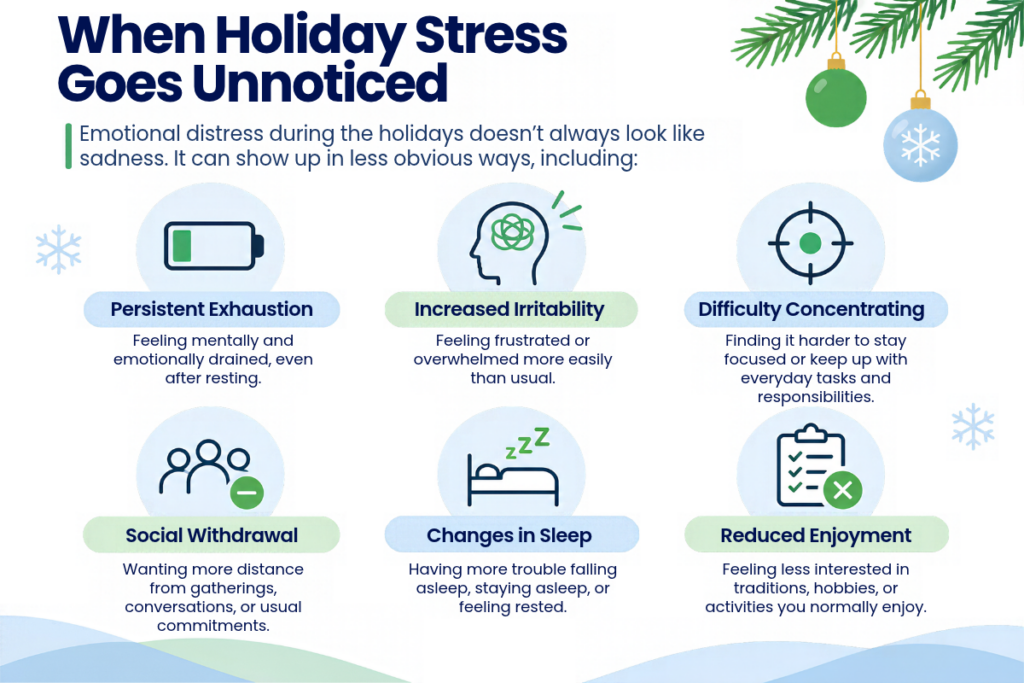
Emotional distress does not always appear as sadness or an obvious sense of being overwhelmed. During demanding periods, stress may influence how someone thinks, behaves, interacts with others, or manages everyday responsibilities.
A person who usually enjoys social gatherings may begin avoiding invitations. Someone who is generally patient may become frustrated by minor inconveniences. Others may notice difficulty concentrating, persistent fatigue, or reduced interest in activities they previously enjoyed.
These changes can be easy to dismiss during the holidays, particularly when busy schedules and additional responsibilities are considered normal parts of the season.
However, recognizing changes in emotional and physical functioning can help individuals identify when stress is becoming difficult to manage.
Possible signs of emotional overload include:
- Reduced emotional tolerance: Everyday frustrations feel more difficult to manage than usual, leading to increased irritability or impatience.
- Difficulty making decisions: Simple choices, such as organizing plans or completing routine tasks, require greater mental effort.
- Loss of enthusiasm: Activities that previously brought enjoyment begin to feel less interesting or rewarding.
- Changes in sleep: Falling asleep, staying asleep, or maintaining a consistent sleep routine becomes more difficult.
- Social withdrawal: Conversations, gatherings, and other interactions begin to feel unusually demanding.
- Persistent exhaustion: Physical or emotional fatigue continues despite opportunities for rest.
These experiences are not exclusive to holiday stress. Similar symptoms can occur with temporary emotional strain, physical health conditions, anxiety, depression, and other concerns.
Their significance depends on factors such as duration, intensity, frequency, and the extent to which they interfere with daily functioning.
Rather than immediately assigning a diagnosis, individuals may benefit from examining patterns in their experiences. For example, someone might notice that irritability becomes more pronounced after several consecutive social commitments or that sleep difficulties increase when financial concerns become overwhelming.
Practical ways to respond to early signs of emotional overload include adjusting demanding schedules, allowing time for rest, maintaining regular sleep routines, and discussing concerns with someone trustworthy. Identifying specific sources of stress can also make it easier to determine which responsibilities or expectations may need to change.
When symptoms persist, worsen, or significantly interfere with everyday activities, seeking guidance from a qualified healthcare or mental health professional can help determine whether additional support or treatment is needed.
Recognizing these changes early creates an opportunity to respond before emotional difficulties become more disruptive.
Holiday Stress or Seasonal Depression? Understanding the Difference
The terms holiday blues and winter blues are sometimes used interchangeably, but they do not necessarily describe the same experience.
Holiday-related emotional distress, commonly referred to as the holiday blues, is not a formal psychiatric diagnosis. It generally describes feelings of sadness, loneliness, anxiety, or emotional exhaustion associated with circumstances surrounding the holiday season.
These experiences may be connected to financial pressures, complicated relationships, grief, social expectations, or changes in routine.
Seasonal affective disorder (SAD), by contrast, refers to depression that follows a recurring seasonal pattern. It is most commonly associated with fall and winter, although depressive episodes can also follow other seasonal patterns. The term winter blues is sometimes used informally to describe milder seasonal mood changes that do not necessarily meet the criteria for depression.
This distinction matters because the timing of emotional symptoms alone cannot determine whether someone is experiencing a depressive disorder.
For example, feeling disappointed or emotionally drained after a difficult family gathering may reflect a temporary response to a stressful situation. Persistent low mood, loss of interest in previously enjoyable activities, changes in appetite or sleep, and difficulty functioning may indicate a need for further evaluation.
The duration, severity, and recurrence of symptoms are important considerations when determining whether emotional changes may be related to depression.
For individuals experiencing holiday-related stress, adjusting responsibilities, establishing boundaries, and strengthening social support may provide relief. Those experiencing persistent or significant depressive symptoms may benefit from professional assessment and evidence-based treatment.
The goal is not to interpret every difficult emotion as a mental health condition. It is to recognize when symptoms extend beyond ordinary emotional fluctuations and deserve additional attention.
Why the Days After Celebrations Can Feel Surprisingly Empty
The emotional challenges associated with the holidays do not always end when celebrations are over.
For weeks, individuals may anticipate family gatherings, prepare special meals, purchase gifts, reconnect with friends, or organize their schedules around upcoming events. These activities create a sense of structure and anticipation, particularly when significant emotional meaning has been attached to the celebrations.
Once the festivities end, the transition back to ordinary routines can feel unexpectedly abrupt.
Decorations are removed, visitors return home, and everyday responsibilities resume. Someone who spent weeks looking forward to seeing loved ones may suddenly feel lonely after their departure. Another person may experience disappointment when a highly anticipated celebration does not bring the emotional relief or fulfillment they expected.
For individuals already experiencing grief, this transition can be particularly difficult. Returning to an ordinary routine may bring renewed awareness of someone’s absence or the changes that have occurred in their lives.
The end of a celebration can also reveal concerns that were temporarily overshadowed by holiday preparations. Financial obligations remain, difficult relationships may still be unresolved, and uncertainty about the future may continue into the new year.
These experiences do not necessarily mean the holiday was unsuccessful. They may reflect the contrast between anticipation and reality, or the recognition that meaningful emotional needs cannot always be fulfilled through a single event.
Managing this transition can involve creating a gradual return to everyday routines rather than expecting an immediate emotional reset. Maintaining contact with supportive people, planning enjoyable activities beyond the holidays, and allowing time to process difficult feelings may help reduce the sense of emptiness that sometimes follows major celebrations.
For someone grieving a previous stage of life, it may also be helpful to acknowledge that the sadness is connected to something meaningful rather than dismissing it as unnecessary nostalgia.
Emotional well-being depends on more than occasional celebrations or significant milestones. Connection, purpose, support, and personal fulfillment are ongoing needs that deserve attention throughout the year.
Rethinking What a Meaningful Holiday Can Look Like
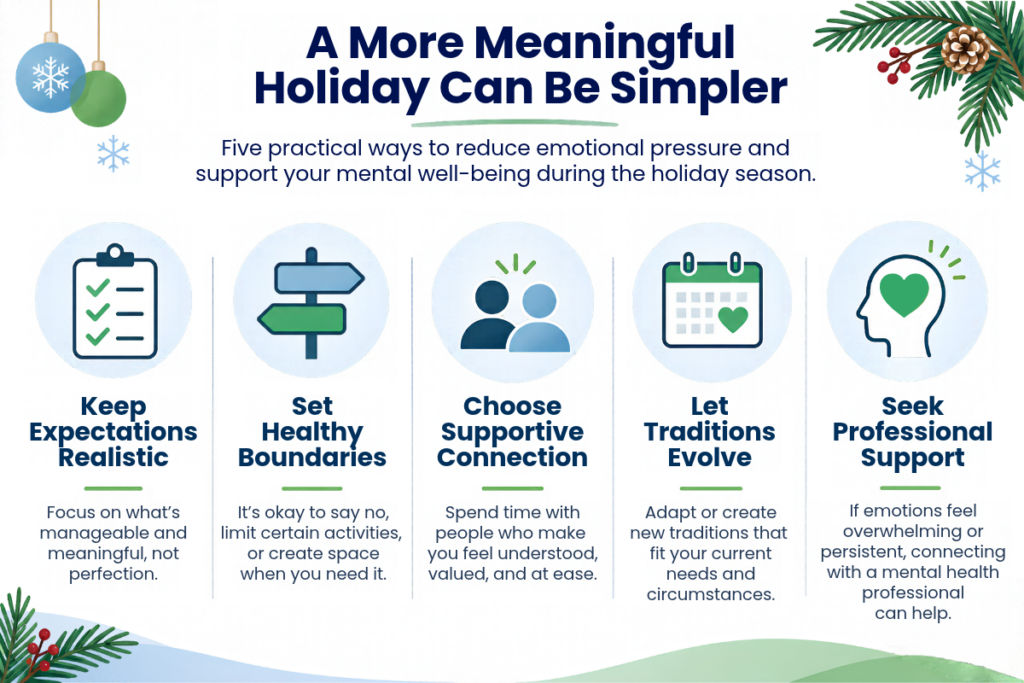
There is no universal formula for navigating an emotionally complicated holiday season. What feels comforting to one person may feel overwhelming to another, and strategies that worked in previous years may no longer reflect someone’s current circumstances.
A more balanced approach involves recognizing personal needs, adjusting unrealistic expectations, and creating opportunities for connection without overlooking difficult emotions.
The following strategies can help individuals approach the holidays with greater flexibility and emotional awareness.
- Keep expectations realistic. A meaningful celebration does not require expensive gifts, elaborate decorations, perfectly organized gatherings, or constant happiness. Identifying a few priorities can help reduce pressure to meet expectations that may not be financially, emotionally, or practically sustainable.
- Establish healthy boundaries. Individuals can decide which gatherings to attend, how much time to spend at events, and which conversations they are comfortable participating in. Communicating these boundaries respectfully can help protect emotional well-being, particularly when family relationships are complicated.
- Make room for grief and changing traditions. Missing loved ones, earlier family experiences, or previous stages of life is a valid emotional response. Rather than forcing familiar traditions to remain unchanged, individuals can adapt celebrations, honor meaningful memories, or introduce new activities that reflect their present circumstances.
- Choose supportive connections. The quality of social interactions may be more important than the number of events attended. Spending time with people who provide understanding, comfort, and emotional safety can be more fulfilling than participating in gatherings out of obligation.
- Recognize when rest is necessary. Holiday schedules can become physically and emotionally demanding. Allowing time between commitments, maintaining healthy routines, and reducing unnecessary responsibilities may help prevent exhaustion.
- Practice awareness rather than forced positivity. Difficult emotions do not need to be ignored or immediately replaced with positive thoughts. Acknowledging sadness, frustration, loneliness, or disappointment can help individuals understand what they are experiencing and identify appropriate ways to respond.
- Seek additional support when needed. When emotional difficulties persist, intensify, or interfere with daily functioning, speaking with a healthcare or mental health professional can provide an opportunity to explore concerns and identify suitable forms of support.
These strategies are not intended to eliminate every uncomfortable feeling. Instead, they encourage individuals to respond to their circumstances with greater understanding, realistic expectations, and flexibility.
A meaningful holiday may involve celebration and connection, but it can also include quiet moments, changing traditions, personal boundaries, and the recognition that emotional well-being deserves attention.
When Emotional Awareness Becomes an Opportunity for Support
Recognizing emotional changes is an important part of maintaining mental well-being, particularly during periods when stress, grief, and competing responsibilities can make personal needs easier to overlook.
Changes in mood, energy, sleep, social engagement, and daily functioning may develop gradually. Paying attention to these patterns can help individuals better understand their experiences and recognize when additional support may be beneficial.
At Precise Behavioral, this understanding is central to an approach that emphasizes personalized, accessible, and continuous behavioral healthcare. Recognizing that mental health needs can change over time, Precise Behavioral combines clinical expertise with innovative digital solutions to support greater awareness, engagement, and connection throughout the care journey.
Through Precise Digital, individuals can access tools such as mood tracking, guided journaling, mental health assessments, and educational resources designed to encourage self-reflection and emotional awareness. When incorporated into provider-supported care, these tools can also offer clinicians valuable insight into changes in emotional well-being between appointments, helping inform more personalized and responsive support.
This approach can be particularly meaningful when emotional difficulties are subtle or develop gradually. Digital tools do not replace professional evaluation or treatment, but they can help individuals recognize patterns, communicate concerns, and participate more actively in conversations about their mental health.
Although the holidays may bring certain emotions into sharper focus, mental well-being deserves consistent attention throughout the year. Understanding emotional changes, acknowledging grief, and knowing when to seek appropriate support can help individuals navigate difficult experiences long after the celebrations have ended.
The Freedom to Experience the Holidays Differently
The holidays are often portrayed as a season of happiness, togetherness, and celebration. While these experiences can be genuine and meaningful, they do not represent everyone’s emotional reality.
Someone may appreciate spending time with family while also needing personal space. Another person may enjoy familiar traditions while grieving the people or experiences that once made them special. Others may approach the new year with uncertainty, disappointment, or a mixture of hope and sadness.
These emotions do not make the season less meaningful.
Perhaps one of the most important shifts is recognizing that emotional well-being does not require constant happiness. It involves understanding how we feel, acknowledging the circumstances influencing those emotions, and responding to ourselves and others with greater compassion.
The holidays do not need to recreate the past, fulfill every expectation, or provide answers to every personal difficulty.
Sometimes, a meaningful season is one that allows us to appreciate what remains, grieve what has changed, and create space for what comes next.
The freedom to experience the holidays differently begins with recognizing that every emotion deserves understanding, even during a season when happiness is expected.
Sources:
- Ahmed, O., Walsh, E. I., Dawel, A., Alateeq, K., Espinoza Oyarce, D. A., & Cherbuin, N. (2024). Social media use, mental health and sleep: A systematic review with meta-analyses. Journal of Affective Disorders, 367, 701–712. https://doi.org/10.1016/j.jad.2024.08.193
- American Psychiatric Association. (2025, November 18). Americans are more anxious than last year about the upcoming holidays; health care and the economy also major concerns for many. https://www.psychiatry.org/news-room/news-releases/americans-more-anxious-about-the-holidays
- American Psychological Association. (2023, November 30). Even a joyous holiday season can cause stress for most Americans. https://www.apa.org/news/press/releases/2023/11/holiday-season-stress
- Flett, G. L., Nepon, T., Hewitt, P. L., Su, C., Yacyshyn, C., Moore, K., & Lahijanian, A. (2024). The Social Comparison Rumination Scale: Development, psychometric properties, and associations with perfectionism, narcissism, burnout, and distress. Journal of Psychoeducational Assessment, 42(6), 685–704. https://doi.org/10.1177/07342829241238300
Written by Gabriella Aaron
About the Authors
Gabriella Aaron is a Clinical Research and Content Development Specialist at Precise Behavioral, Inc., with a background in Medical Microbiology and a passion for digital mental health solutions.
Editorial Contributors
This piece was edited by Greta Baker and Kirsten Guiliano.