At Precise Behavioral, we use clinical science to guide every layer of design.
The digital mental health space is expanding quickly, yet many apps offer surface-level solutions. They promise guidance and “quick fixes,” but many lack clinical depth, professional oversight, and research-backed foundations. They often look appealing, but only a few are truly grounded in evidence-based care.
Precise Digital was built differently. Our platform is created by clinicians who understand what meaningful support actually requires. The app blends an intuitive, user-friendly experience with a strong foundation in clinical research, offering patients support that is thoughtful, rigorous, and trustworthy.
Every layer of the platform reflects this commitment. The structure, workflows, content, personalization features, engagement tools, and safety measures are informed by clinical science. This ensures that the care we deliver is not only of high quality but also aligned with what works in real mental health treatment.
At the end of the day, patients deserve tools designed with their well-being in mind. Precise Digital makes that possible by turning evidence into everyday support that genuinely helps people feel understood, supported, and cared for.
Workflow Design Anchored in Research
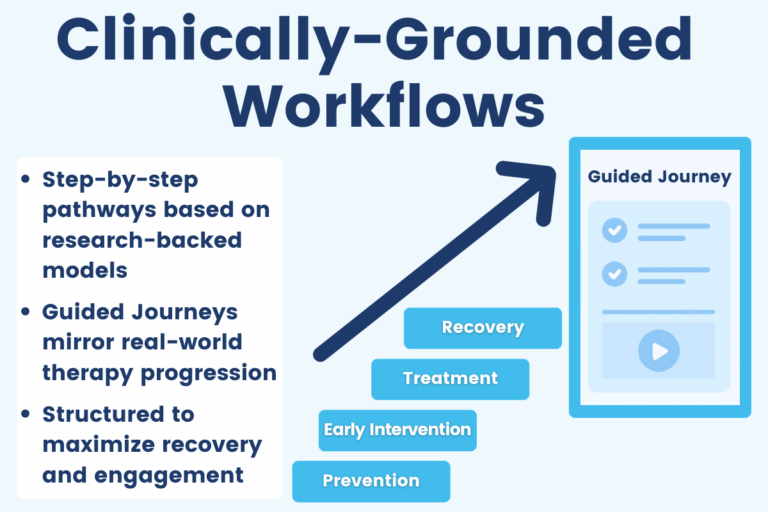
Our product workflows are informed by research-backed frameworks, including stepped care, recovery-stage models, and relapse-prevention pathways. Systematic reviews show that stepped-care models yield better recovery and response rates than usual care, reinforcing our commitment to structuring user pathways around proven clinical sequences (Firth, Barkham, & Kellett, 2015). This allows the user experience within our platform to follow a progression that reflects the structure of effective clinical care.
Guided Journeys as a structured clinical pathway:
A central part of our workflow is our own creation: Guided Journeys. These pathways, developed by our clinicians, are structured sequences created for patients struggling with common mental health challenges, such as anxiety or depression. Each journey includes evidence-based articles, videos, and worksheets arranged step-by-step to reflect how therapy typically unfolds. This brings clarity, consistency, and clinical integrity to the digital care experience.
By integrating Guided Journeys into our workflow, we create predictable, supportive pathways that make it easier for users to build insight, practice skills, and move toward meaningful improvement. It’s available right at the patient’s fingertips, wherever they are and whenever they need it.
Evidence-Based Content and Assessments
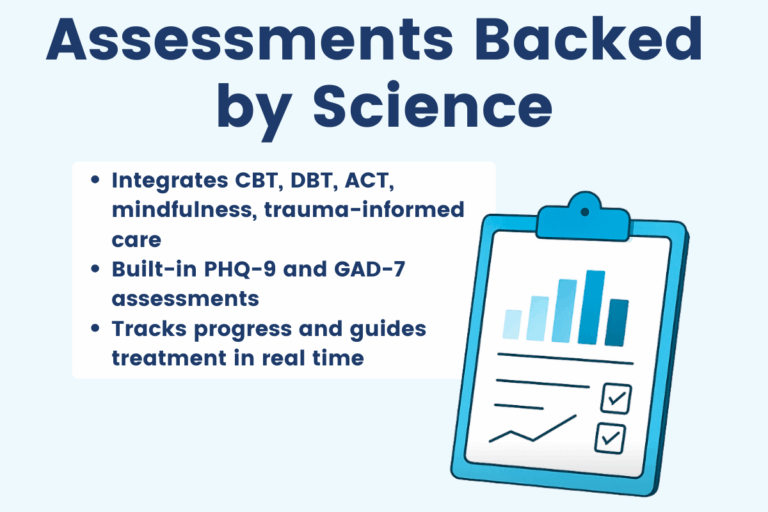
We incorporate therapeutic modalities supported by decades of research—CBT, DBT, ACT, mindfulness, and trauma-informed practices—into our content library. Our assessment framework uses gold-standard measures such as PHQ-9 and GAD-7. Clinicians can assign these assessments directly within the app, prompting patients to complete them at key points in care. Results automatically populate on the clinician dashboard, allowing providers to track progress, identify trends, and make informed treatment decisions in real time. And because engagement strongly influences how effective an intervention can be, embedding assessments within a seamless, guided workflow improves adherence and data quality (Elkes et al., 2024).
The outcome? Interventions and evaluations that clinicians trust, users can meaningfully act on, and a measurement workflow that strengthens continuity of care.
Personalization Guided by Science
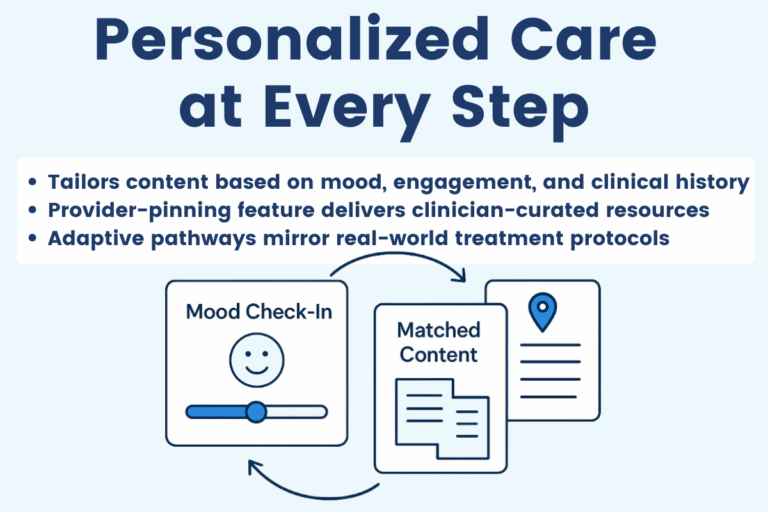
We tailor care based on symptom severity, demographic factors, engagement style, and clinical history, but also through the small, everyday signals that matter. Each time a patient checks in, they log their mood, and our system uses this real-time data to surface articles and resources that match how they’re actually feeling in the moment. This helps users feel seen and supported with content that’s relevant, timely, and emotionally attuned to their needs.
This approach is reinforced by emerging research. A recent sequential multiple assignment randomized trial (SMART-design) demonstrated that tailoring resources significantly increases engagement, validating the importance of adaptive personalization in digital mental health (Rouvere et al., 2025). Our platform applies these same principles by continuously adjusting what users see based on their responses and progress.
Our provider-pinning feature adds an additional layer of personalization by allowing clinicians to curate a tailored experience for each patient. Providers can pin specific articles and videos directly to a patient’s home screen, ensuring they’re engaging with the most clinically appropriate material. This creates a more connected, collaborative care experience where patients know their clinician is guiding them every step of the way.
This level of personalization reflects adaptive treatment protocols used in clinical practice, ensuring users receive interventions that genuinely fit their needs rather than broad one-size-fits-all solutions.
Engagement Strategies Rooted in Behavioral Research
Our engagement approach draws from cognitive-behavioral science and behavioral activation. We design prompts and nudges that support action, encourage self-reflection, and sustain progress without guilt or pressure. Research reinforces the value of this approach: a qualitative study published in BMC Public Health found that digital tools that convey “humanness,” show goal progression, and offer flexibility help build a digital therapeutic alliance—an essential component for long-term engagement and meaningful improvement (Taylor et al., 2025).
Guided Journeys act as engagement anchors. The structured format of Guided Journeys creates natural momentum. By presenting users with a clear next step, one clinically designed, not chosen at random, we reduce overwhelm and increase completion. This structure supports habit formation, builds confidence, and lowers dropout by giving users a predictable path forward.
Building Better Outcomes Through Evidence-Driven Design
Precise Behavioral doesn’t just build digital tools; we design systems grounded in clinical science. From our structured Guided Journeys to our personalized provider-pinning feature, every layer is thoughtfully crafted to support real-world mental health outcomes.
This clinically informed approach reduces risk, strengthens trust, and builds scalable pathways that organizations, health systems, and partners can confidently depend on. It also creates an infrastructure where meaningful, measurable mental health care becomes achievable at scale. If your organization is ready to deliver care that is both effective and evidence-driven, this framework is designed to help you get there.
Sources:
- Elkes, J., Cro, S., Batchelor, R., O’Connor, S., Yu, L.-M., Bell, L., Harris, V., Sin, J., & Cornelius, V. (2024). User engagement in clinical trials of digital mental health interventions: A systematic review. BMC Medical Research Methodology, 24(1), 184. https://pubmed.ncbi.nlm.nih.gov/39182064/
- Firth, N., Barkham, M., & Kellett, S. (2015). The clinical effectiveness of stepped‑care systems for depression in working‑age adults: A systematic review. Journal of Affective Disorders, 170, 119‑130. https://pubmed.ncbi.nlm.nih.gov/25240141/
- Rouvere, J., Griffith Fillipo, I. R., Romanelli, M., Sharma, A., Mosser, B. A., Nguyen, T., Rushton, K., Marion, J., Althoff, T., & Pullmann, M. D. (2025). Personalization strategies for increasing engagement with mental health websites. JMIR Mental Health, 12(1), e73188. https://mental.jmir.org/2025/1/e73188/
Taylor, T., D’Alfonso, S., João Tralhão Dolan, M., Yiend, J., & Jacobsen, P. (2025). How do users of a mental health app conceptualise digital therapeutic alliance? A qualitative study using the framework approach. BMC Public Health, 25(1), Article 2450. https://link.springer.com/article/10.1186/s12889-025-23603-5
Written by Emily Yi and Greta Baker
About the Authors
Emily is a Behavioral Health Consultant at Precise Behavioral, Inc., and a Licensed Clinical Social Worker (LCSW). She specializes in supporting emotionally intense teens, adults, and families through creative therapy.
Greta Baker is a Multimedia Content Coordinator at Precise Behavioral Inc., with a background in English Literature from the University of Virginia. She combines her passion for writing and mental health with her experience in digital communications to support advocacy and awareness.
Editorial Contributors
This piece was edited by Gabriella Aaron.