
We live in a world that rarely pauses. With just a few taps or clicks, we can message someone across the globe, scroll through endless updates, join virtual meetings, and share life’s biggest moments in real time. Connection has never been easier or more constant.
Still, something essential is missing for many people. Despite being more digitally connected than ever, millions of individuals quietly experience a deep and persistent sense of loneliness. This is not the kind that comes from being physically alone. It’s the kind that exists in crowded rooms, busy inboxes, and endless conversations that never quite reach how someone is truly feeling.
Depression has become one of the defining mental health challenges of our time, but it rarely appears the way people expect.
When Depression Looks Like Functioning
Mental health struggles are not always easy to recognize. Depression often exists beneath the surface, hidden behind routines that appear perfectly ordinary. Someone may be attending meetings, caring for their family, laughing with friends, or crossing every task off their to-do list while quietly carrying an overwhelming sense of emptiness. They continue to show up, stay productive, and seem “fine” to everyone around them, even as they battle exhaustion, hopelessness, or a loss of joy internally. The absence of visible tears or isolation does not mean the absence of pain, which is why kindness and compassion can make a difference in ways we may never fully see.
People can appear functional on the outside while quietly struggling internally. In today’s performance-driven world, depression is often masked by productivity, perfectionism, and the pressure to appear in control. Beneath the surface, many individuals are struggling to stay afloat.
A Growing Mental Health Challenge
The scale of depression today reflects a global public health concern. The World Health Organization estimates that approximately 332 million people worldwide are living with depression. This makes it one of the leading causes of disability globally and a major contributor to the long-term health burden (World Health Organization [WHO], 2025).
In the United States alone, an estimated 21 million adults experienced at least one major depressive episode in 2021. Among young adults aged 18 to 25, nearly one in five were affected, highlighting how significantly depression impacts younger populations (National Institute of Mental Health [NIMH], 2023). Following the COVID-19 pandemic, global rates of anxiety and depression increased by an estimated 25% in just one year, highlighting how rapidly mental health can deteriorate during periods of sustained disruption and uncertainty (WHO, 2022).
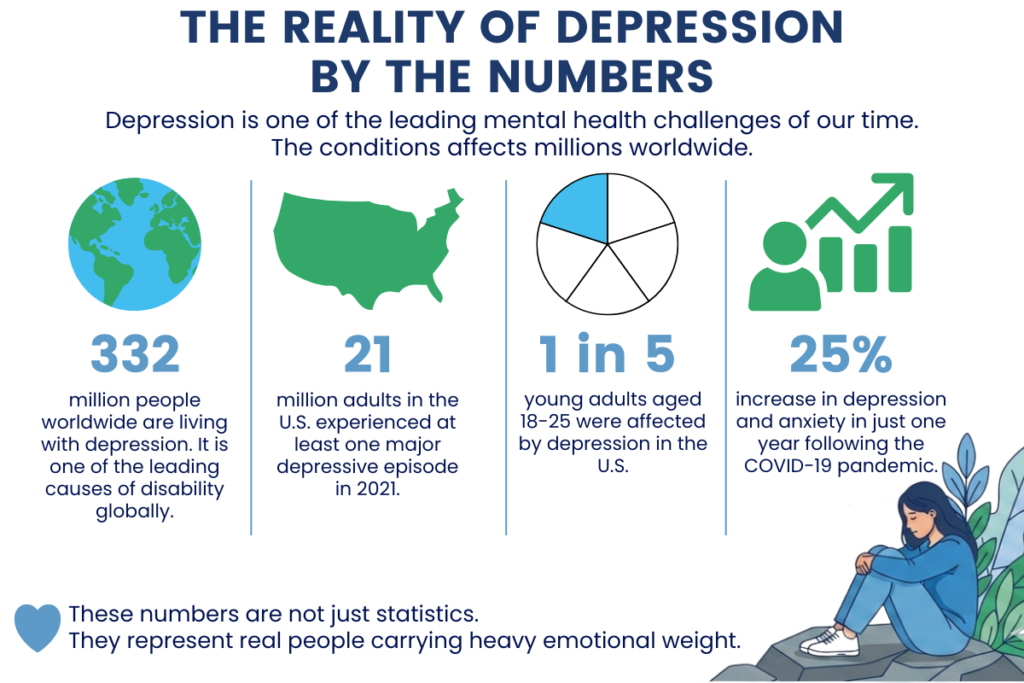
These numbers are not just statistics; they represent real people navigating everyday life while carrying invisible emotional weight. They are students trying to focus during lectures, parents holding families together while feeling exhausted, professionals struggling to stay engaged, and individuals silently hoping someone will notice that something is wrong.
Why Modern Life Feels Emotionally Heavy
Depression has always existed, but modern life has introduced new layers of strain. Social media, while designed to connect people, often creates subtle but persistent comparisons. Users are exposed to curated moments of success, happiness, travel, relationships, and achievement, while the anxiety, loneliness, or burnout behind those moments remain unseen. On difficult days, this can create the impression that everyone else is thriving while one is struggling.
At the same time, work has also become increasingly “always-on”. Emails, notifications, and messaging platforms blur the boundaries between personal time and professional responsibility, leaving little opportunity to fully disconnect. Financial stress, academic pressure, caregiving responsibilities, and rising living costs further contribute to a constant undercurrent of stress. Over time, this sustained pressure can lead to burnout, emotional exhaustion, anxiety, and depression; conditions that are often deeply interconnected and difficult to separate.
Depression Is More Than Feeling Sad
Everyone experiences sadness, but depression is different. It affects how the brain regulates mood, energy, motivation, and even physical well-being. For some, it presents as deep sadness or hopelessness. For others, it is more subtle, showing up as emotional numbness, lack of motivation, or a disconnection from things that once brought joy.
Even simple tasks, such as replying to a message, preparing a meal, or getting out of bed, can feel overwhelming. Depression is not a sign of weakness or lack of effort. It is a clinical condition that requires compassion and appropriate care.
Recognizing the Signs
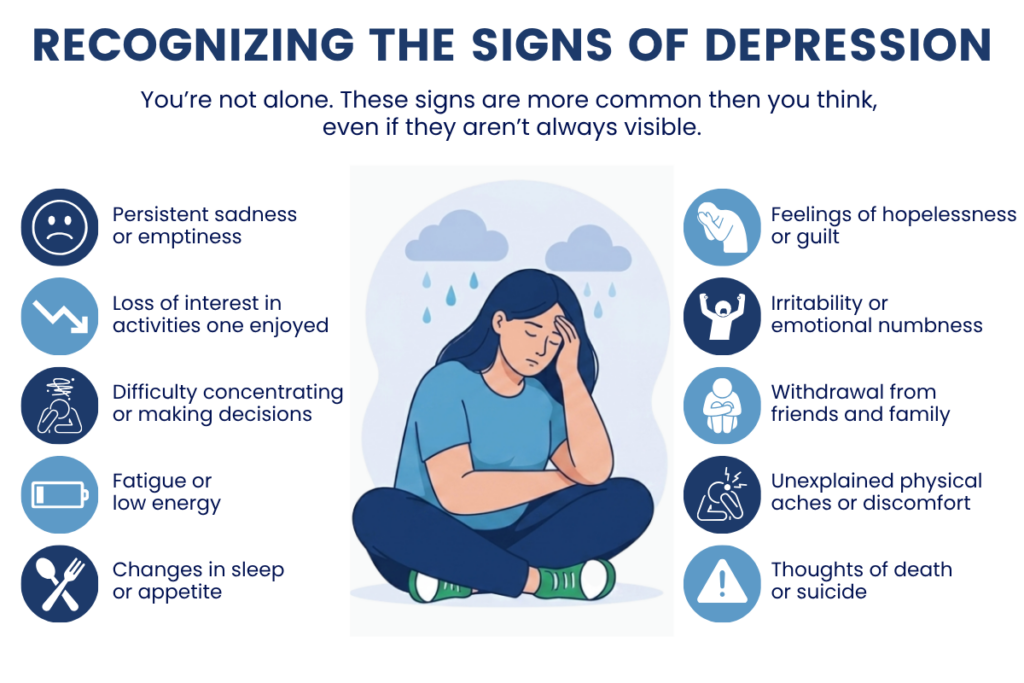
Depression can present differently from person to person. Common signs include:
- Persistent sadness or emptiness
- Loss of interest in activities once enjoyed
- Difficulty concentrating or making decisions
- Fatigue or low energy
- Changes in sleep or appetite
- Feelings of hopelessness or guilt
- Irritability or emotional numbness
- Withdrawal from friends and family
- Unexplained physical aches or discomfort
- Thoughts of death or suicide
When these symptoms persist for two weeks or longer and begin affecting daily functioning, seeking professional support becomes important (WHO, 2025).
The Hidden Cost of Staying Silent
One of the most significant barriers to mental health care is stigma. Many people delay seeking help due to fears of judgement, misunderstanding, or being perceived as weak. Others minimize their symptoms, convincing themselves they simply need to push through because everyone else appears to be coping.
Depression rarely improves in silence. Early support can make a meaningful difference in recovery, whereas delaying care often allows symptoms to intensify and daily functioning to decline. Reaching out for help is not a sign of failure but an important step toward stability and healing.
Stigma, however, is only one piece of the challenge. Even when individuals recognize they need support, obstacles such as limited provider availability, long wait times, scheduling constraints, and gaps in continuity of care can make it difficult to receive timely treatment. Expanding access requires solutions that integrate into people’s lives and provide support when and where it is needed.
Rethinking Mental Health Delivery
Mental health care is no longer confined to traditional office-based visits. Today, digital health is transforming how support is delivered, monitored, and experienced. Remote care models, virtual consultations, and real-time clinical coordination are expanding access while enabling providers to identify concerns earlier and maintain consistent engagement between visits. This approach is especially valuable in high-acuity and fast-moving clinical environments, where timely intervention and continuous monitoring can have a meaningful impact on patient outcomes.
At Precise Behavioral, we are working at the intersection of clinical care and innovation to support this transformation. Through our AI-enabled platform, Precise Clinical, we help deliver psychiatric care across a wide range of settings, including emergency departments, inpatient units, and outpatient care. By combining telehealth services, specialized clinical teams, and artificial intelligence, the platform analyzes patient-reported outcomes, behavioral patterns, and remote monitoring data to identify meaningful trends and generate actionable clinical insights. These capabilities support personalized treatment planning, enable early identification of changes in mental health status, and help clinicians prioritize timely interventions. Rather than replacing clinical expertise, AI serves as a decision-support tool that enhances care coordination, strengthens continuity of care, and empowers providers to deliver more proactive, data-informed, and patient-centered mental health services.
Care That Meets People Where They Are
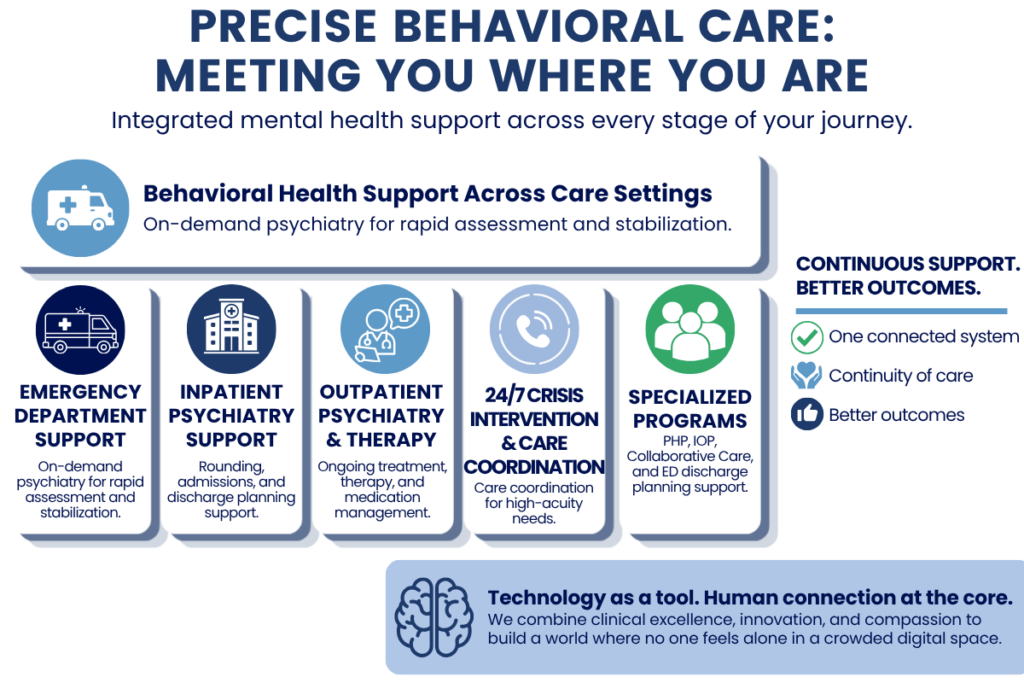
Modern behavioral health challenges rarely exist within a single setting. Care needs often span across emergency, inpatient, outpatient, and community environments, making integrated models of support essential.
Precise Behavioral delivers care through an expansive nationwide provider network that includes psychiatrists, nurse practitioners, therapists, and care coordinators. This approach extends support to extend beyond a single appointment or setting, ensuring continuity across the care journey. Through Precise Clinical, psychiatric expertise is delivered across multiple points of care, including:
- On-demand psychiatry in emergency departments for rapid assessment and stabilization
- Inpatient psychiatry support for rounding, admissions, and discharge planning
- Outpatient psychiatry and therapy for ongoing treatment and medication management
- 24/7 crisis intervention and care coordination for high-acuity needs
Specialized programs including Partial Hospitalization Programs, Intensive Outpatient Programs, Collaborative Care Management, and structured emergency department discharge planning help bridge the gap between crisis and recovery. Rather than functioning as isolated services, these layers work together to support continuity, reduce fragmentation, and guide patients through transitions in care.
Technology as a Tool for Human Connection
Technology is often seen as a source of disconnection. In mental health care, it can serve the opposite role when used intentionally. AI-driven tools, remote monitoring, and coordinated care platforms help bridge communication gaps, ensuring sure that no one falls through the cracks. By streamlining the administrative and clinical workflows, tools like Precise Clinical allow providers to focus more fully on the human element of medicine.
True connection is about being seen, heard, and supported. By integrating clinical excellence with modern accessibility, we can build a world where everyone has a place to turn when they need support.
Sources:
- World Health Organization. (2025). Depressive disorder (depression). https://www.who.int/news-room/fact-sheets/detail/depression
- National Institute of Mental Health. (2023). Major depression. https://www.nimh.nih.gov/health/statistics/major-depression
- World Health Organization. (2022). Mental health and COVID-19: Early evidence of the pandemic’s impact. https://www.who.int/publications/i/item/9789240050860
Written by Gabriella Aaron
About the Authors
Gabriella Aaron is a Clinical Research and Content Development Specialist at Precise Behavioral, Inc., with a background in Medical Microbiology and a passion for digital mental health solutions.
Editorial Contributors
This piece was edited by Greta Baker and Kirsten Guiliano.